Tick - Tick - Tick
The Economy Bomb
Legislative attacks on America's most successful, productive and prolific taxpayers represent a ticking time-bomb for our economy.
John Gaver
October 30, 2010
|
 Publishers note: This article is an annually updated feature of Action America, beginning with this article's first publication, in 2000. Each year, we update it with the latest tax collection data and links to recent legislation and news items, related to this developing threat to our economy. This year, we have a lot of new information. Please note our extensive use of links to unimpeachable sources.
An insidious, creeping cancer is eating away at our economy. Not only the Income Tax, but other legislative and regulatory attacks on success are forcing many of the people who pay the lion's share of taxes, to leave the United States and because of some of that legislation, those producers are now taking all of their wealth with them, thus very disproportionately reducing the tax and investment base in the United States.
That's a pretty bold statement. But I'll back it up. However, before I go into the details of this virtual economic time bomb, I want to make sure that we're all on the same page. So let's establish a few basic facts, about taxes and taxpayers, as a foundation.
Fact: |
The top-earning 1% of US taxpayers pay more than one third (38.02%) of all federal individual income taxes collected. (Source: IRS) |
Fact: |
The top-earning 1% of US taxpayers earn just over one fifth (20.0%) of all federally taxable individual income. (Source: IRS) |
Fact: |
The top-earning 1% of US taxpayers pay more than half again (50.6%) more of the total individual income tax load than they did when President Reagan left office (1989 tax year - 25.24% of tax load). (Source: IRS) |
Fact: |
The top-earning 1% of US taxpayers are facing frivolous lawsuits in phenomenal numbers, simply because our lax tort laws make them easy targets of opportunity. |
Fact: |
The top-earning 1% of US taxpayers are in more danger of government seizure (forfeiture*) of their private property than ever before in our history, due in part, to the Patriot Act. |
Fact: |
The top-earning 1% of US taxpayers are Leaving the USA at the highest rate in history. (Source: INS/Census Bureau & Zogby International estimates) |
The facts cited throughout this article are based upon statistics and calculations derived from data released by the US Internal Revenue Service, the US Census Bureau and other reputable sources (note: we realize that considering the IRS to be a reputable source is reaching). Links are provided to the source data, throughout this article. We ask you to note the impeccable sources of the statistics presented here, since it is the integrity of those sources, as well as their variety, that seals the case. We invite you to follow the links provided and see for yourself. The facts are real and cannot be denied. Examine the numbers, use your own assumptions and do the math for yourself. When you recalculate the numbers, using your own assumptions, you will see just how serious the problem really is. It's real and it's daunting and it could very well spell disaster for the US economy, if certain positive actions are not soon taken. |
The percentages cited above are not some bureaucrat's pie-in-the-sky projections, but rather, they are the totals of actual IRS receipts, that are released every year by the IRS, roughly 18 months after the close of each tax year. A link to the file on the IRS web site, containing the raw IRS data for this year (in Excel format) and an explanation of it can be found in the the companion article to this article, "1986-2008 IRS Collections Data by Income Category".
Let's start by looking closer at some of that IRS data and see how those numbers work out.
-
There were roughly 140 million tax returns filed in 2008. (Source: IRS)
-
The IRS collected $1.03 trillion in personal income tax in 2008. (Source: IRS)
-
The top-earning one percentile of taxpayers (1.4 million taxpayers) earned 20% of the income earned in 2008. (Source: IRS)
-
The top-earning one percentile of taxpayers (1.4 million taxpayers) accounted for $392.1 billion in income tax paid in 2008. (Source: IRS)
-
Based upon that IRS data, the top-earning one percentile of taxpayers (1.4 million taxpayers) paid over one third (38.02%) of the $1.03 trillion in total individual income tax collected by the IRS in 2008. We invite you to do the math for yourself ($392.1 billion / $1.03 trillion).
-
Based upon that data, the top-earning one percentile of taxpayers (1.4 million taxpayers) paid almost double their share of taxes (1.9 times) in relation to their share of income earned in 2008. Do the math (38.02% of taxes / 20% of income).
-
The top-earning one percentile of taxpayers (income over $380,354 in 2008) paid in excess of 50% more of the total tax burden than they did when President Reagan left office. At that time their share of the tax burden was only 25.24%. Do the math (38.02% / 25.24%). (Source: IRS)
What's wrong with making the successful pay more tax?
Many people who look at the above statistics and see that the top-earners are paying far more than their share, will immediately say, "So, what's wrong with making the people with the most money, pay a higher tax rate? After all, they can afford it."
Regardless of the fact that the successful, by and large, have "earned" their success, many people seem to think that the successful have, in some way, committed some horrible sin, by achieving more than their less industrious counterparts. Those people ignore the fact that while they were out having a good time, the successful were going to school, working hard and sacrificing, in order to generate the income that improved their lifestyles. The result of ignoring that fact, is that those people think that since the successful have more money than them, the successful should be forced to pay a larger proportional share of the tax burden, as penance for the perceived "sin of success".
Yet others, are suffering under the left-wing, media-fostered delusion that the most successful people don't pay tax. Of course, this delusion is solidly disproved by the actual IRS data, that shows that the top-earning 1% pay almost 40% of the taxes that are actually collected.
But the important point is that such arguments are not only absurd, but completely immaterial. The fact that some people even raise those arguments serves to show just how totally uninformed of the real problem now facing the United States, are many people, including many in the halls of government.
The problem to which I am referring, is a direct result of the position in which the successful now find themselves. These successful people, who are made up of the educated, the entrepreneurs, the risk-takers and the job-creators, are being systematically backed into a corner by our government. The most productive members of our society are:
-
paying almost double their share of taxes,
-
facing frivolous lawsuits by the greedy, in ever growing numbers (yes, the poor can be greedy, too),
-
losing any semblance of privacy in their business transactions,
-
having their business dealings saddled with onerous Patriot Act and Sarbanes-Oxley Act requirements that often take so much time and cost so much money that otherwise profitable deals end up costing money, if they happen at all and
-
having their property confiscated (forfeited*) by the government, at an ever increasing rate
Everything for which those top taxpayers have worked so hard, is now being threatened by the same government, whose job it is to protect all of its citizens from just those types of abuses.
Don't get me wrong. I'm not trying to make you feel sorry for all those "poor mistreated millionaires." Frankly, I don't care what you think of them. That's because what you or i or anyone else "thinks" of them doesn't matter.
I'm just trying to get you look at the situation from the point of view of the people whose response to all of this success-punitive legislation, will shape our economy, in the near future.
You see, if you understand their motivation, then you will understand that what our government is doing in this regard, can only make the situation worse. You'll realize that the successful see all of this, not just as an attack on success, but as an attack that is getting worse, by the day and that threatens everything for which they have worked so hard to achieve.
In fact, since the original publication of "Tick-Tick-Tick - The Economy Bomb", in 2000, more oppressive legislation aimed squarely at top-earning taxpayers, has made matters even worse. But to make matters far worse, Obama is now promising to further punish the successful, with even more taxes, to fund his social programs.
But, before you start shedding crocodile tears for those poor top income earners, there's another thing that an understanding of the successful should tell you. They have both the wherewithal to thwart such attacks and the entrepreneur mind-set to carry it off.
Remember that these people are almost all problem solvers. They didn't get to where they are by giving up, whenever things get a little tough. To them, these new legislative attacks represent only a speed bump on the road to even greater success. They will do what successful people always do, when faced with a problem. They will simply shift gears and veer off in another direction.
It is, however, the direction that many of our top taxpayers are now headed, that make these continuing attacks on success, a real threat to those who have not achieved such a level of success. The direction though, isn't a rhetorical direction. It's a physical direction and that direction is largely south. But it could just as well be east, west or north.
The successful are leaving.
The point is that our most prolific taxpayers are leaving. You see, it's this natural response of the successful, to the problems that our government is creating for them, that represent a ticking economic time bomb, for the rest of us and indeed, for the entire US economy.
So I ask you, considering all of the attacks on success, should we then be surprised if our top-earning taxpayers, facing an untenable situation, take the only legal route left open to them, for protecting everything for which they have worked so hard? Now, I'm not asking if you think that their actions are right or fair - only if we should be surprised, when people who are attacked, take the only remaining legal way out?
It's the same thing that's happening with Californians, moving to other states, but on a national level. Government created conditions in California have become so punitive that many of those who can afford to leave, are moving themselves and their businesses to other states. Of course, as we are all seeing, that exodus of wealth only serves to make matters worse for those who remain in California.
But while the main-stream media is making a big deal about people moving from California, to other US states, they're ignoring the fact that large numbers of wealthy US citizens are leaving the USA for other countries that offer the kind of freedoms that we used to have.
Many of our most productive citizens have already reached what I call their "government abuse threshhold" and chosen expatriation, as their last remaining legal option for protecting all that they have worked so hard to acquire. We're talking about ordinary people, who are just trying to protect what they have earned, just like the people leaving California.
However, besides punitive levels of taxation on upper income earners, there are many other governmental assaults on success. The USA Patriot Act, two-thirds of which has absolutely nothing to do with fighting terrorism, created numerous privacy and financial problems for all Americans. While the Patriot Act seriously hurt the rights of all US citizens, it was the successful, whose rights were impacted most.
Other oppressive measures, aimed at top taxpayers were hidden in other unrelated bills, such as the Homeland Security Act, the Health Insurance Portability and Accountability Act, to name just two of the worst. In fact, before George W. Bush left office, he signed into law, the first ever US "Exit Tax" (hidden in the benign-sounding, Heroes Earnings Assistance and Relief Tax Act of 2008 (HEART) - H.R.6081 and today, we're looking at the complete government takeover of healthcare, which will be paid for on the backs of our most productive citizens... well, at least on the backs of those productive citizens who remain.
It can't be denied. Successful Americans see these measures as direct assaults on everything for which they have worked so hard and they are leaving the USA for more wealth friendly climates, at the highest rate in history.
"So what? Let'em leave!"
One of the most absurd statements that I have heard, in response to the above facts is, "So what? Let'em leave! We don't need'em! We don't even want'em!"
Some well-meaning people, instead of looking at the underlying cause of this flight of many of our most productive citizens and largest taxpayers, simply react and call these fleeing producers, "unpatriotic" of even "traitors". Those who don't understand the problem, mistake the industriousness of the successful, for greed. They also incorrectly believe that the successful want to leave their home country. That, of course, couldn't be further from the truth.
In fact, most of those who are leaving strongly resent the fact that their own government has created an untenable situation for them. They resent that, instead of protecting their rights and the assets that they have worked so hard to acquire, that government now represents a substantial threat to all that they have worked to build.
What's worse, is that belligerent attitude is actually contributing to the problem. When successful people first start considering a move to another more success-friendly country, there are two things that they might hear from those who learn of their possible flight. They might hear something like, "We'll really hate to see you go. The community sure needs the jobs that your company creates. I hope you'll decide to stay." Or they might hear, "If you want to be unpatriotic, just go ahead and leave. We don't need your kind. We don't even want you, you traitor!"
Now which of the above responses do you think will be most likely to entice them to stay? Think about it...
Those uninformed critics, who call top taxpayers names, for even thinking about leaving and tell them that we don't want them, are actually making matters much worse. After all, it's much easier to leave your home country, if you think your are no longer wanted there. First, the government treats them like chattel and then other Americans call them names for taking the last legal option for protecting what they have earned.
The question that many may now be asking is, "Why should we want these people to stay?" It they want to leave the greatest nation on Earth, why should we try to stop them? Well the answer is simple.
Their flight creates serious problems for YOU.
It's all a matter of perspective. To those who haven't achieved such success, this may still look like the greatest nation on Earth. But if the USA still looked like the greatest nation on Earth, from the viewpoint of those who have the wherewithal to live wherever they want, why would so many of those top taxpayers be fleeing? Think about it...
Some uninformed Americans see those top taxpayers, who are fleeing the US, for more success-friendly jurisdictions, as "cowards", "unpatriotic" and "quitters", who we don't want around, anyway. I'll address those points later in this article. For now, suffice it to say that what people think about these successful expatiates (commonly referred to as "expats") is completely immaterial to the problem at hand.
Love'em or hate'em, when our most successful citizens and largest taxpayers leave, it creates extremely serious problems for those who remain in the United States.
So why is the fact that a handful of successful people are leaving and taking their money with them, such a problem for you? After all, wouldn't it take tremendous numbers of wealthy people leaving, to have a noticeable effect upon our economy? Well, it would seem so,... that is, if you fail to work the numbers.
To understand the threat that this nearly invisible flight represents, we must look at what this all means for those taxpayers who remain. For out purposes, we'll look initially only at the top 1% of income earners (that 1.4 million taxpayers, who made more than $380,354 in 2008) and what their leaving would mean for those who remain?
You see, until you look at the actual numbers and do the math, it doesn't appear to be a serious issue. But, it is very serious. So lets look at those IRS numbers again and this time, let's do the math.
Just how serious is this problem, anyway?
|
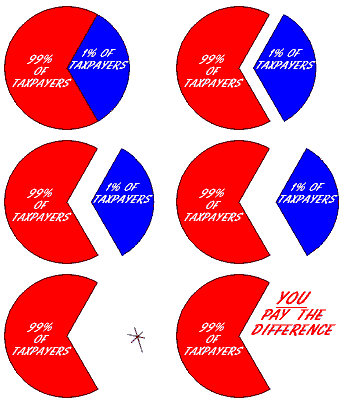
The pie chart to the right shows in blue, the percentage of individual income tax revenue for which the wealthiest one percentile of taxpayers were responsible, in 2008 and the percentage of tax revenue that the rest of us paid, is shown in red. The full circle represents the total amount of personal income tax revenue that is collected each year, to fund the government for one year (not including deficit spending).
This chart demonstrates that if only the top-earning 1% of taxpayers were to leave the USA permanently, those who remain would all be in a world of hurt, since those who remain would face an almost two-thirds (61%) tax increase, just to stay even.
After all, no sane person would expect Congress to cut spending by a whopping $392 billion (the amount of tax paid by the top 1% of earners), just because a mere 1% of taxpayers leave. It has become a truism that even in the face of decreasing revenue, Congress doesn't cut spending. They'll just pass on the additional tax burden to the rest of us, in order to fund their spending addiction.
So what this means, is that without that 1% of the wealthiest Americans, every remaining taxpayer would have to pay almost two-thirds more in taxes, just to equal what was lost. Can you afford a more than 61% tax increase?
Those who argue that Americans with the most money should be taxed at a higher rate, will find themselves being taxed at a much higher rate, instead. If just the top-earning 1% leave and you're paying $5,000 in income tax today, then imagine paying an additional $3067 in taxes. If you're paying $25,000 in tax, then imagine paying an additional $15,336. If you're paying $100,000 - well if you're paying $100,000 in income tax, there's a good chance that you already have your bags packed and your second passport in hand, so you don't need to imagine anything.
Although, while not all of any particular income group will leave, you must consider that the higher the income group, the greater is the motivation to leave.
There will always be those whose asset base is tied to the US. Bill Gates, for instance, would have a difficult time leaving, since Microsoft is such a US-centric company. But, who knows? After all, Microsoft has been significantly increasing its offshore programming staff, in recent years and software is their business. Beyond the obvious cost savings and tax benefits, offshore outsourcing relieves companies (and their principals) of ties to any single country. So, who knows - maybe even Gates is preparing for the worst.
So considering the Gates scenario, there are probably few businesses, if any, that would absolutely tie its principals to the United States. That's because almost every business model can be adjusted to produce a profit, anywhere in the world. So, as long as it's safer and more profitable to do business in the USA, businesses will stay in the USA. But if the government makes it less profitable or too risky to operate a particular business in the USA, than in some other country, then that business, its owners and the associated jobs will probably move to that other country. That's Economics-101.
To put this into perspective, just look at California. Business and people are fleeing California, for other states and for largely the same type of reasons many others are leaving the USA. In the case of California, it is the state government that has made it far too costly to do business in California.
But many business owners across the USA are finding that there is no longer a safe or profitable place to do business in the USA. So like the people fleeing California, they are fleeing the USA. It has nothing to do with making a political statement. It's just an economic decision that has been forced on them.
No matter how the tax and spend members of both parties try to spin it, the higher the income level of a particular taxpayer, the greater is the level of governmental attacks on his assets and privacy and it follows that the greater will be that person's financial motivation for leaving. And as it turns out, even ties to a US-centric business won't keep them from leaving. At best, such ties might only delay that flight.
Then, the burden shifts to lower income earners.
Consider that as the most wealthy leave, the additional tax burden shifts to the next level down, so lets think about the fact that the top-earning 5% of income earners pay 58.72% of all taxes collected. While the majority of the wealthiest 1% are "escaping", do you think that the top-earning 5% will just be sitting around waiting for a 61% tax increase? Of course not. And, when they leave, the tax bite on those who remain will far more than double!
Then, of course, there is the top earning 10%. But, I wouldn't worry about them. By that time, the government will have either taken the very unlikely measure of repealing all of the wealth punitive laws and abolishing the Income Tax, in lieu of a National Retail Sales Tax, to encourage the wealthy to return or they will have done what so many other repressive governments have done, when faced with native capital flight, on a massive scale - they will have closed the borders to keep the remaining wealth in the country.
But then, as shown by every last case where that has happened in the past, ranging from Nazi Germany in the 30's to South Africa in the 70's and 80's, to to the case of Malaysia, several years ago, even closing the borders to capital, only increases native capital flight, albeit on an illegal basis.
So, maybe you should worry about losing the top-earning 10% after all, because if they can manage to get out with their wealth in tact, your taxes will more than triple!
Have I got your attention?
Although it's interesting to think about, for other reasons that I will explain, I seriously doubt that it will ever get that far. The problem goes much deeper.
But, staying with just the tax issue for now, let's look at the actual numbers.
Let's do the math.
Here is the math for the top-earning 1%:
100% - 38.02% of taxes lost = 61.98% of taxes left
38.02% = 61.3% additional tax burden for those remaining 61.98%
Here is the math for the top-earning 5%:
100% - 58.72% of taxes lost = 41.28% of taxes left
58.72% = 142% additional tax burden for those remaining 41.28% THAT'S FAR MORE THAN DOUBLE!
Here is the math for the top-earning 10%:
100% - 69.94% of taxes lost = 30.06% of taxes left
69.94% = 234% additional tax burden for those remaining 30.06% THAT'S MORE THAN TRIPLE!
Think about it. If only the top-earning one percentile of taxpayers leave the United States, the remaining taxpayers will find that they will have to pay an additional 61% more in taxes.
Wouldn't it take a long time for that many taxpayers to leave?
When folks hear these facts and do the math, most see the potential for a problem developing, but many fail to see how it could be of immediate concern. They look at that IRS data and think that it can't be all that bad. After all, although 1% sounds small, it really amounts to 1.4 million taxpayers.
This raises the question, "Wouldn't it take a tremendously long time for enough upper income taxpayers to leave, to make any real difference?" Well in fact, the answer is a very decisive "No".
You see, what the above numbers don't tell us is that we could lose that critical one percentile much quicker than most people might imagine. In fact, even by conservative estimates, it's very likely that a sizable portion of our rising federal deficit is the result of expatriations driven by success punitive legislation, in the past.
As legislative attacks upon people with any significant degree of success continue, more and more successful Americans will reach their own personal "government abuse threshhold" and flee for more success-friendly environments.
So just how many are leaving?
The number of Americans leaving is phenomenal!
Since most of those who leave, are seeking privacy, they avoid leaving many trails. Therefore, factual data about expatriation is very difficult to come by.
In fact, the INS (now the BCIS) addressed this counting problem in the "2000 Statistical Yearbook of the Immigration and Naturalization Service" (6.2 MB download), which is based upon US Census Bureau data.
"In some areas these deficiencies persist because of the inherent difficulty in estimating the numbers, as is the case for emigration and illegal immigration. As a result, no detailed tables on these two categories are included in the Statistical Yearbook."
Even so, using that Census Bureau data, the 2000 Statistical Yearbook paints a dismal picture for the USA. Here is how they summed up expatriation.
Approximately 300,000 are projected to emigrate annually in the 2000-2005 period. In the longer run, emigration is projected to increase steadily...
300,000 a year!
All of a sudden, that 1.4 million taxpayers that make up the top 1% of income earners doesn't sound like such a large number, after all.
But it gets worse... much worse, in fact.
Based upon all of our previous research, we had expected the numbers to be higher than those reported by the INS and Census Bureau - quite a bit higher, in fact. We also wanted something more than just the Census Bureau's best "guess", so we went looking for more reliable data and we found it. But what we found, left even us in awe.
More than 3 Million US Citizens relocate abroad every year.
You read that right. New evidence now reveals that more than three million (3,000,000) Americans are relocating abroad every single year.
On July 28, 2008, the respected polling firm Zogby International released the results of seven polls that they conducted between 2005 and 2007. These polls differ sharply, from the Census Bureau data. But this should be of no surprise.
Keep in mind that the Census Bureau is in the business of counting people. It's not their concern why people are here or why they aren't. Their job is simply to count. For their purposes, the people whom they can't account for are either dead or gone. The only way they have of determining which, is to guess and as it turns out, that guess was extremely conservative.
On the other hand, Zogby is an independent polling firm that asked questions specifically designed to determine how many Americans were planning to leave or were considering that possibility. Furthermore, people know that Zogby maintains no private data, so most folks are generally far more willing to accurately answer the Zogby questions, than Census Bureau questions.
Here, in their own words, is what Zogby found (emphasis added - we don't want the liberal media to miss anything).
“Focusing on households rather than individuals (and excluding households in which any member has been sent overseas either by the government or private companies), a series of recent Zogby polls commissioned by New Global Initiatives, a consulting firm, yielded surprising results: 1.6 million U.S. households had already determined to relocate abroad; an additional 1.8 million households were seriously considering such a move, while 7.7 million more were "somewhat seriously" contemplating it. If the data collected in the seven polls conducted between 2005 and 2007 are fairly representative of the current decade, then, by a modest estimate, at least 3 million U.S. citizens a year are venturing abroad.”
Notice that Zogby went to great length to insure that critics could not say that their numbers were skewed by the inclusion of people who simply spend a lot of time overseas on business, but have no intent to expatriate. They specifically excluded households in which any member had been sent overseas by his employer.
This exclusion would actually have the effect of skewing the numbers lower - not higher. That's because the people who were excluded from these polls - those having lived overseas - are much more likely to eventually make a permanent move offshore, than the public at large. So considering that the Zogby numbers are, if anything, skewed toward lower numbers of expats, think what it means that they still they came up with more than three million Americans, who will "relocate abroad" every year. Then consider that they even called that "a modest estimate."
Note too, that Zogby used the term, "relocate". They were specifically avoiding counting those whose move overseas was "temporary". They were counting only those who were "relocating" — in other words, those who had no specific plans to return and whose move was likely to be permanent.
So, far from being an inflated number, three million expats a year is very likely on the conservative side. The true number, were we able to determine it factually, is quite likely, much higher.
But it gets even worse.
Those surveys were conducted between 2005 and 2007. So let's move forward to April 25, 2010, when the New York Times reported, in an article titled, "More American Expatriates Give Up Citizenship", that more US citizens renounced their citizenship in the last quarter of 2009, than in all of 2008. That's not just an estimate, either. It's drawn from quarterly reports, published in the Federal Register, that names every person who renounced his citizenship in the previous quarter.
That's right. The US government now publishes a quarterly list of the names of everyone who renounces their citizenship. At least, that was the original idea. In fact, it's been going on since 1996.
If you don't believe something like that can happen in the USA, see it for yourself. We provide links to those quarterly lists, in the Federal Register, titled, "Quarterly Publication of Individuals, Who Have Chosen To Expatriate", on our Taxpatriates Page.
I mentioned that it was the original idea that those lists should include the names of all expats. But between the time the bill was passed and implementation, those in charge decided that it wasn't wise to list everyone, who renounces, since it would draw attention to the problem. So instead, the list only contains the names of those who meet certain criteria. Can you guess the criteria?...
That's right. Wealth.
The original idea of those lists was that they were supposed to embarrass potential expats into staying. Some congressional supporters of the bill even referred to those lists as, "The List of Shame". However, it didn't work out quite the way they expected. In fact, most expats today, look at being on that list, almost as a badge of honor.
But keep in mind that the people whose names appear in those lists are just the very few, who were wealthy and further, only those wealthy, who took the formal step of renouncing. Many expats value their privacy, over that symbolic badge of honor. Many more, upon acquiring a second citizenship, simply stop paying US taxes, allow their US passport to expire and fall off the US government's vassal radar. Sure, that last option isn't legal. But they see it in much the same way that our Founding Fathers saw renouncing English rule and for much the same reasons, including punitive taxes.
Furthermore, whether you think that right or wrong is totally irrelevant to solving the problem. That's because regardless of your opinion of these actions, the successful are still leaving, in huge and growing numbers. Your opinion or mine, won't change that. Our problem is to figure out what will.
But before we get to that, there is a question that this increase in the formal rate of expatriations raises. "If there are more US citizens renouncing today, than in the past, what effect will that have on the estimate of more than 3 million Americans leaving every year? Is the actual number of Americans leaving increasing at a similar rate?
Well, just look at the cause of those renunciations - more and more wealth punitive legislation, higher taxes promised by Obama, for those who have achieved even a moderate measure of success, attacks on free speech, attacks on privacy, frivolous lawsuits, inordinate restrictions on an individual's use of his own private property and much more.
Those motivations for renouncing citizenship are the exact same motivations that are driving US citizens to leave, in the first place. The only difference is simply a matter of scale. People just have different "government abuse thresholds".
Granted, not all of those 3,000,000 or more US citizens, who are leaving each year, are rich. But, think about it. How many do you really think are poor?...
How many do you think are even middle class?...
Have I got your attention yet?
It's our most prolific taxpayers, who are leaving.
Just keep in mind that poor people come to the United States, mostly with their hand out and bypassing legal immigration channels, because of all the economic benefits that our government offers them, using our tax dollars, which translates to mean mostly tax dollars of the successful.
Why would the poor leave? In fact, for all of their protestations, our poor have it much better here, than the middle class in just about any other country in the world; that is, for those countries that even have a middle class.
The only class of people who can have it better in another country are those who are at least moderately wealthy - roughly, the top-earning ten percent (those who earned at least $113,799, in 2008).
Personally, I think that it would be very conservative to expect that 80 to 90 percent of those leaving are at least, somewhat wealthy. But, don't use my estimates. Use your own common sense. How many of those 3 million expats a year do you really believe are poor?
If 80% of that 3 million expats a year, are among the top 10% of taxpayers, then that amounts to 2.4 million of our largest taxpayers leaving every year. Even if only half of those 3 million expats are wealthy, that's still one and a half million top taxpayers leaving every year. By any reasonable estimate, it would be very easy for the USA to lose more than half of our tax base in only a few short years.
In fact, recent laws aimed at curbing this flight of our most prolific taxpayers, actually amount to increased attacks on success and as such, are creating an even greater motivation for those who can afford to leave, to do so soon.
Government attempts to force the successful to stay in the USA are having exactly the opposite effect.
As a result of at least two of these laws, designed to punish the wealthy for leaving, the wealthy began taking ALL of their investment capital with them when they left and therein, lies the true problem.
In the past, when successful people moved offshore, they would most often leave the majority of their wealth in the USA, where it was considered to be "safer" and where it would earn more money. Neither is any longer the case.
Our money is no longer safer here. We see the US dollar strain, weakening under the weight of the Bush and Obama bailouts, ObamaCare and increased social spending. We see the federal government taking over huge companies like AIG and GM and then forcing profitable GM dealerships to close. We watch, as the government confiscates private assets, under the tenuous guise of drug or Patriot Act enforcement, thereby shifting the burden of proof from the government, to the citizen. And let's not forget the IRS, which seems to always choose which conflicting part of the IRS code they will enforce, by choosing the part of the code that will put the taxpayer in the most debt to the IRS. Then to top it off, the Obama administration is holding talks about how to nationalize your 401Ks and IRAs.
As for their investments earning more money in the USA, that's long gone, as well. In fact, the best performing mutual funds in the world, are offshore funds. But US citizens are prohibited from taking advantage of them. Also, emerging markets now offer expat investors tremendous returns. Do you think that Donald Trump would be building a new Trump Tower in Panama City, Panama, if he didn't see tremendous profit potential there, with low risk?
So what we have, is a combination that encourages expats to take most or all of their wealth with them, when they leave. The US government is making US based investments less secure, while new foreign investments offer more safety and higher returns.
The problem is that when the wealthy leave and take their money with them, it creates severe problems for the rest of us, since we're the ones who have to make up the difference in lost taxes. What really surprises me is that even a few well-meaning conservatives, who realize that the real problem is Native Capital Flight, have fallen into the greed trap, right along with the liberals.
In fact, the most inane argument that I've heard on this issue has come uniformly from both ends of the political spectrum and goes something like, "Well, we just need to pass more laws to keep the wealthy from taking their money out of the country."
Duh?!!!
It's precisely those laws that are some of the primary reasons why Native Capital Flight has become such a severe problem, in the first place. To the successful, each such law represents yet another brick in an economic Berlin Wall that they see being erected by our government and meant to limit their financial options.
Just remember that the successful are largely problem solvers. They're risk takers. They are the kind of people who manage to find opportunity, even in adversity. So, each time the government attempts to limit the financial options of the successful, the only effect that it has, is to make those top taxpayers take a closer look at options that they had not previously considered viable.
In this case, they now have to consider the option of leaving the country of their birth and the possibility of never coming back. But to a problem solver and risk taker, that’s a small price to pay, to recover his lost freedom.
The result of these increasingly oppressive laws is that instead of forcing the successful to stay here, along with their money, they are actually giving the successful no other legal choice, but to move more of their wealth out of the US, while they still can, in preparation for a time when a new round of such laws makes it impractical for them to stay.
Although leaving is often far from their first choice, they're beginning to realize that their own government may soon leave them no other choice. In fact, many have already been forced to make that choice.
Some high profile expatriations
Here is a list of names that you might recognize. All of them have renounced their US citizenship, in favor of that of another less oppressive jurisdiction.
-
John “Ippy” Dorrance (Campbells Soup) - Ireland
-
Kenneth Dart (Dart Container) - Belize
-
Sir John Templeton (Templeton Fund) - Bahamas
-
Mark Mobius (Templeton Emerging Markets Fund) - Germany
-
Fred Freible (Locktite) - Turks & Caicos
-
Michael Dingman (Abex & Ford) - Bahamas
-
Joseph Bogdanovich (Star-Kist & H.J. Heinz)
-
4 of the J. Paul Getty grandsons, Richard Minns, Ted Arison and more…
That's just the short list and that list alone, represents billions in lost tax base.
In fact, Sir John Templeton, who was born in Tennessee and who still pays a tremendous amount in foreign taxes, is on record, stating that he saved more than $100 million in taxes, in the first year after his expatriation... and, that's just what he "saved"! He was still paying a lot in offshore taxes. So think about the total amount that he would have "paid" in US taxes, had he stayed.
If they were willing to go on record, every person on that list would probably have a similar story. That list of just 13 people, probably represents more than a billion dollars in lost taxes and that's a billion dollars each and every year, since they left.
That's just 13 people. What about the 3 million a year, who are leaving. What happens when they finally reach their personal "government abuse threshold", cut all ties with the USA and stop paying taxes?
It creeps like a virus.
The legislative issues contributing to this growing exodus have gone largely unnoticed, since the growth in expatriation of our largest taxpayers has taken place so quietly, over so many years.
It really began back in 1968, shortly after the riots at the Democrat National Convention in Chicago. This is not to say that it was a problem at that time. Let's just say that the trickle of expatriates that any country experiences became a barely noticeable flow at that time. If it had stayed at that level, it would not be a problem today. But, indications are that the flow increased slowly, but steadily until the 1980's.
In 1981, the Reagan administration rolled back some of the success-punitive, anti-privacy laws and tax rates that were contributing to this exodus and indications are that it did have a significant effect. In fact, officially, not a single US citizen renounced his US citizenship the next year.
That statement deserves repeating.
Not a single US citizen renounced his US citizenship the next year - not one.
That fact alone, should tell you something.
But such is the nature of the income tax and the lust for ever more power, which often infects elective officeholders, that no sooner than President Reagan left office, his successor, George H. W. Bush, resumed the attacks on success and they have been increasing, since. So has expatriation of our largest taxpayers.
Evidence from key foreign consulates indicate that the number of US citizens requesting application forms for citizenship or permanent residence in those countries, jumped significantly in the months after the Democrats in Congress tricked George Bush (the elder) into the largest tax increase in US history, up to that time.
Granted, requesting citizenship forms or information on citizenship is not expatriation. But details on the number of citizenships actually granted is far more difficult to come by. It is however, reasonable to assume that as the number of forms requested increases, so does the number of forms submitted.
The point is that the timing of those requests tie back to the motivation.
Other jumps occurred just after the Clinton tax increase and again, after the HIPAA legislation (discussed below) was signed into law, in 1996.
Indications are that in the first year of the George W. Bush administration, expatriations increased much more slowly, as the successful seemed to think that maybe Bush (the junior) would relieve some of the pressure on them. But, shortly after Bush signed the USA Patriot Act into law, all of the indicators show that expatriations quickly shifted into high gear again.
Just the timing of those increases point even further toward the fact that those who are leaving are successful, since each of those events represented an attack on success and on no other socio-economic group. The slower increases in the first year of the Bush administration indicate that the successful expected Bush to roll back some of the Clinton administration's success punitive legislation. But, with the passage of the Patriot Act, the successful knew that they had figured Bush wrong and expatriation spiked once more.
The evidence is there, if you look for it.
Our government is becoming more and more oppressive to the successful and making it increasingly expensive for those top taxpayers to stay. Although the US Census numbers and the Zogby reports don't attempt to determine the income category of these expats, there is a lot of ancillary data that points to the fact that it's our most prolific taxpayers, who are expatriating and at phenomenal rates. This ancillary evidence ranges from tell-tale social indicators to more hard numbers and statistical indicators.
Social Indicators -
At the social indicator end of the spectrum, only a few short years ago, it was very difficult to find the single small bar or restaurant in most small foreign countries, where American expats would gather. Today, they are more common than car dealerships in Houston (even, before Obama forced a lot of the Republican owned car dealerships to close). It seems that there are now quite a few such expat bars in every small country.
Consider too, the phenomenal growth in construction of not inexpensive US-style housing and condominiums in many of the worlds most popular expat destinations. Ambergris Key, in Belize has seen a tremendous building boom of high end residences in recent years. The photo below, shows Panama City, Panama, as I saw it just last week. Every yellow arrow indicates a building under construction.

Most of those high-rises are less than 10 years old and there are probably more than 75, in various stages of construction, in and near Panama City. Just from this angle, I count 24 buildings under construction and those are just the ones that I could make out from this photo. The far right arrow identifies the new Trump Tower. I counted more than 40 construction cranes just between my hotel and the airport. But the important fact is that most of those high-rises are condos, with only a few business buildings mixed in.
Of course, in other parts of the country, there is a less visible building boom in US-style single family dwellings. New high-end master planned communities abound in areas of Panama like Altos del Maria, el Valle and Boquette. In fact, in the Boquette area, you are almost as likely to hear english spoken, as spanish.
So what's behind this building boom in popular expat destinations? The answer should be obvious. They're trying to keep up with the expatriation of wealthy Americans, coming to their shores. After all, people like Donald Trump wouldn't be investing so much money down there, if they thought it was over-built.
Also, in recent years, we have seen quite a number of organizations that exist for the sole purpose of helping people move themseves and their assets offshore and those organizations are seeing record growth. They include, but are not limited to The Sovereign Society, International Living, Escape Artist and Live and Invest Overseas". Former US Congressman Bob Bauman, who is now the legal council for both the Sovereign Society and International Living, told me:
"During 2009 and continuing today, the Sovereign Society and International Living, have both experienced a marked increase in interest among many people who are considering moving assets and themselves offshore.
This is evidenced by unprecedented increases in our membership and much higher attendance at our offshore conferences.
My personal talks with many of these Americans shows a very real fear about the current policies of the US government..."
----- Bob Bauman, JD - (March 2010)
But what is not said here, is that the principle customers of those organizations tend to be successful people, who have the wherewithal to afford the services of such organizations and to live wherever they want. Those organizations wouldn't even be in business if a lot of upper-income Americans weren't seriously thinking about moving offshore and require such services.
Statistical Indicators -
On the other end of the spectrum are the statistical indicators. Let's begin with the Forbes Magazine annual lists of the "400 Wealthiest Americans" and the "Worlds Billionaires". An analysis of those lists in recent years, shows that in the ten years between 1999 and 2009, the number of billionaires in the US climbed by a mere 27%, with a 20% growth in wealth, while during that same time period, the number of billionaires worldwide climbed by a whopping 166%, with a 90% growth in wealth. This means that the number of worldwide billionaires grew at a rate six times faster than US billionaires and the net worth of those worldwide billionaires grew four and a half times faster.
In other words, while the growth in the number of billionaires in the US was just barely enough to account for inflation and their net worth was even less, the growth in the number of billionaires worldwide, along with their net worth, was moving ahead at a rapid pace.
The question that this raises is, "Are our billionaires just not as smart as foreign billionaires or are our billionaires leaving and becoming foreign billionaires?"
This is just one more indicator that US billionaires are moving offshore. Of course, if the billionaires are moving offshore, it's likely that other wealthy Americans are doing the same.
Granted, the Forbes lists probably leave out some billionaires whose asset base is not easy to locate. But Forbes has been using the same criteria and methodology to build those lists for years. So although the actual number of billionaires in each year's list may not be accurate, the percentage of change, from year to year, should be a fairly close approximation of reality.
This isn't anything new. Back in April of 2002, National Review reported on this exodus. In an article, titled, "Bermuda Straight - Government greed is causing corporate flight", Veronique de Rugy wrote,
"As taxes continue to soak up a larger percentage of the GDP, the number of U.S. citizens moving out of the country is increasing. Unfortunately for them, the United States is one of the few countries that taxes its citizens on global income, even when they are living abroad. As a consequence, some Americans living abroad have renounced their U.S. citizenship to protect their family's interests."
Of course, de Rugy was talking about just those Americans who formally renounced. There are millions of others who simply take citizenship in some other country, stop paying US taxes and just never return.
Sure, as I mentioned earlier, that's illegal. But I've lived overseas and I've talked with some of those expats. And while they agree that it's illegal, they also point out that it was illegal for our founding fathers to refuse to pay England's exorbitant tax on tea. Although I prefer to stay legal, I have to admit that they have a point. Furthermore, they don't worry about it being illegal, because they have another passport and never plan to return to IRS jurisdiction.
Expats often call this sort of undocumented or stealth expatriation, "escaping without notifying the jailer". It should also be noted that, among expats, the popular term for expatriation is, "escape." If expatriates feel that way about the US government, is it any wonder why so many just leave quietly?
Yet, I should mention that every last expat to whom I have spoken, has expressed to me, outrage that it was his own government, that instead of protecting his rights and property, made it impossible for him to stay in the country that he still calls home. They feel like they have been forced into exile, just to be able to keep what they have earned.
Also, speaking of de Rugy, I should point out that she knows just a little more about this phenomena of government-abuse-driven expatriation, than her colleagues at National Review (also at the Cato Institute and the Mercatus Center at George Mason University). In fact, she pointed this out in the opening to the above referenced article, writing, "As an oppressed French taxpayer, I finally decided to move to the United States." You see, de Rugy was forced to leave her home country, just as those about whom she now writes.
But there's more evidence that it's the top taxpayers, who are leaving.
The Merrill Lynch/Cap Gemini Ernst & Young "2003 World Wealth Report" addressed this issue. The headline of the press release for that report announced "...Number of U.S. Wealthy Individuals Drops — Goes Against Global Trend". Notice that they pointed out that this "Goes Against Global Trend." This backs up our findings from the Forbes data.
According to that report, there were 100,000 fewer millionaires in the US at the end of 2003, than at the end of 2002, during a time when worldwide wealth was growing. There is no doubt about it. The wealthy are leaving in large and increasing numbers.
To be fair, the "2004 World Wealth Report" shows that the number of wealthy individuals in the US increased the next year (2004). But that was due largely to low interest rates and greater growth in world GDP than had been seen in more than 20 years. Everyone was making money then. So, this doesn't mean that the wealthy stopped leaving.
In fact, other indicators are just too solid on this point. It simply means that due to exceptional worldwide economic conditions, low interest rates in the US and helped along by rising oil prices and the continued effects of the Tax Relief Act of 2001, more Americans managed to "grow" their wealth here at home, than did in 2003. But even so, worldwide wealth growth was still outpacing that of the US. So while 2004 was a good year for everyone, we can't ignore that it was better for foreigners and that fact didn't escape the notice of many successful US citizens, who left that year.
The question that hangs ominously in the air is, "How long will these new millionaires be willing to take the abuse that our government increasingly heaps upon high net-worth individuals?"
Again, let's do the math.
As shown above, government data indicates that over 300,000 mostly wealthy Americans would choose expatriation each year, from 2000 to 2005 and increase, beyond that time. In fact, that rate has been increasing at a rate significantly higher than the growth of wealth in this nation, for many years.
Of course, the Zogby numbers, which are likely to be much more accurate, places that number at over 3 million.
Even so, for our calculations, we will only assume that the number of top taxpayers who are leaving remains stable, at the Census Bureau's extremely low estimate of 300,000, which further assumes that Obama and Congress hold back any more legislation that the successful see as detrimental to themselves, their businesses or their rights.
However, now that the Bush and Obama bailouts have pushed the deficit to obscene levels and Obama's socialized healthcare threatens to destroy what little the Bush administration left of the US economy, that's a very rosy assumption... OK. it's an impossible assumption. But this is, after all, meant to present a "best case" scenario - for demonstration purposes, only.
So continuing on, if we look at recent history, currently proposed legislation and other disincentives, it would probably be reasonable to assume a 10-20 percent growth in expatriation every year. But as I stated before, my purpose in this calculation, is to be as conservative in my projections as possible. So let's just stick with the fairy tale, stable rate assumption, based upon the low Census Bureau estimates, from 2000.
Then, after you see how bad the best case scenario is, we invite you to recalculate, using your own realistic assumptions, to get an idea of just how serious a problem we're really facing. Ask yourself, "What if the Zogby numbers are on target? What if it is 3 million expats a year, instead of 300,000? What then?"
But for now, sticking with the conservative numbers, multiply it out and you'll find that if that 300,000 rate holds steady through 2013, the number of wealthy Americans that may have left the United States in that time (including 2008 - the last reported tax year), could easily reach over 1.8 million or well over the 1.4 million taxpayers that make up the top 1% of taxpayers (see table).
Note: Numbers expressed in thousandsYear |
2008 |
2009 |
2010 |
2011 |
2012 |
2013 |
Annual Expatriation |
300 |
300 |
300 |
300 |
300 |
300 |
Total Since 2006 |
300 |
600 |
900 |
1200 |
1500 |
1800 |
That's 1.8 million US expats from 2008 to 2013 and that's using an extremely conservative, stable rate assumption. If the Zogby numbers are accurate, then that number could just as easily be 18 million.
Granted that not all of those expatriates are going to be wealthy. But, ask yourself, how many of those expatriates you really think will be poor or even middle class. Use your own estimates, based on common sense. Just keep in mind that the poor don't leave unless they have to. They can't afford it.
You can see that what appears to be a minor problem today, could turn out to be a catastrophe for the US economy tomorrow. Remember that in 2008, the top-earning 1% amounted to 1.4 million taxpayers. Depending on how many of those expatriates are wealthy, it's quite possible that a significant portion of our most substantial taxpayers could be gone by the time we have a chance to vote out Obama and his congressional enablers - from both parties. How much longer can this continue?
In fact, since this wealth flight has been going on for some time and it's so difficult to estimate emigration levels, it's anyone's guess just how many wealthy taxpayers have already been forced to leave. So ask yourself just how much of our current deficit can be attributed to the loss of tax revenue from the many wealthy Americans, who have already been forced to leave. Think about it...
Then consider this. Just to play the devil's advocate for a moment, let's assume that things are not as bad as the picture that I have painted. Suppose that Zogby is totally wrong and that even the Census numbers are high, by a whopping 50%, meaning that the expatriation rate is only half as high as the US Census numbers indicate and that expatriation is not increasing. Even using such absurdly benign assumptions, we still have a serious problem.
Do the math.
Regardless of how some in government may try to twist the numbers, it cannot be denied. Laws that punish success are the principal cause of a tremendous flight of our most successful and most prolific taxpayers and that ultimately is seriously undermining our economy.
Then consider that in reality, those 2000 Census numbers and the Zogby polls are much more likely to be off in the other direction, since many things have changed for the worse, in recent years and continue to change. Consider Bush's anti-privacy Patriot Act, Obama's socialized healthcare and other spending initiatives that Obama has announced that he intends to pay for on the backs of the successful, not to mention a dozen or more other pieces of success-punitive legislation that have been enacted (with the support of both parties, I might add) since the 2000 Census and (2008) Zogby numbers were released.
If that's the case, then expatriation is increasing at an even higher rate than either the Census Bureau or Zogby predicted. It might be much worse...
"Don't worry," the White House and most of our members of Congress tell us. "It's not really that bad. We have it all under control." Of course, it's not what they say that tells us how serious the problem really is. It's their own actions.
Actions speak louder than words.
The real evidence of the massive scale of native wealth flight is not in any statistics, but rather in the almost panic reaction of our government. Oh, our congresscritters and officials of the Internal Revenue Service and other federal agencies deny that expatriation of the wealthy is more than a minor problem. After all, if native capital flight were perceived to be a serious problem, folks would start asking why it's so serious, which would lead right back to legislation and regulations, for which those elected officials were responsible. They can't afford that. But, the government's own actions belie their words. Consider this.
If native capital flight is not a very serious problem, why did both Republicans and Democrats in Congress suddenly find it necessary to add an amendment to the Health Insurance Portability & Accountability Act of 1996 (HIPAA) (26 USC 877(a)(1)), that claims the right to tax expatriate Americans for 10 years after they renounce their US citizenship and are taxpaying citizens of another country, with no ties whatsoever, to the USA, if the US government thinks that one of their reasons for expatriation was to "legally" avoid US taxes? (Find that hard to believe? Click on the link and read it for yourself.) Actions speak louder than words.
Why did our lawmakers find it necessary to include in that ominous HIPAA legislation, yet another provision (26 USC 6039G(e)(3)) aimed at slowing expatriation by requiring that the names of all who have expatriated during the previous quarter, be published in the Federal Register, as an attempt at intimidating those who might be considering expatriation? (It's in there, too. Click on the link and read it for yourself. Also see "US Taxpatriates" at http://www.ActionAmerica.org/taxecon/taxpats.html, for links to those quarterly lists.) Actions speak louder than words.
Why then, did they follow-up that abominable law with the Illegal Immigration Reform and Immigrant Responsibility Act (IIRIRA), which modified the Immigration and Nationality Act (8 USC 1182(a)(10)(E)) to allow the government to permanently deny "wealthy" expatriates entry into the United States, if the US government thinks that one of their reasons for expatriation was to "legally" avoid US taxes?
In other words, our government considers the wealthy to be on a par with smugglers, prostitutes, drug dealers and child abusers, who are also denied entry to the USA. (Find that hard to believe? Click on the link and read it for yourself.) Actions speak louder than words.
And, what does the government use, in each of those laws, to determine if tax avoidance was among the reasons for a taxpayer's expatriation? Income and/or net worth. If an expatriate had a net worth of $500,000 (raised to $2,000,000 in 2004) at the time of expatriation or earned more than $100,000 per year (raised to $125,000 in 2004) for the five years immediately preceding expatriation, then he is assumed, without recourse, by the US government, to have expatriated to avoid US taxes. (It's in those links, in surprisingly easy to understand verbiage. Follow the links and read it for yourself.) Actions speak louder than words.
They obviously don't care if poor people expatriate. But, these actions prove that they are beginning to panic about the number of wealthy individuals who are leaving and taking their money with them. Actions speak louder than words.
These laws are clearly aimed at punishing anyone, who has the audacity to have more money than the government thinks they should have, leaving with their wealth intact. What reason would the IRS and lawmakers have for passing such autocratic laws, if they are not very seriously concerned about the number of wealthy taxpayers who are leaving IRS jurisdiction? Think about it... Actions speak louder than words.
Could an Exit Tax be next on the horizon?
A true exit tax is considered to be one of the most ominous signs of a desperate government. Such exit taxes are typically used only by repressive regimes, as a way to keep their "subjects" under the thumb of the government.
In the USA, the 10-year expatriation tax, passed in 1996, was bad enough. But it was not a pure exit tax. A pure exit tax would be far worse. Such a tax must be paid at the time of renunciation and would include a mark-to-market tax on unrealized capital gains, among other things.
But if you're waiting for that to happen, before you believe that we are in a world of trouble, then you can stop waiting. In fact, if you are waiting, then like so many other Americans, you missed it.
In 2008, Congress passed and George W. Bush signed into law, the first ever US Exit Tax, as a part of the Heroes Earnings Assistance & Relief Tax Act (Public Law 110-245). (Don't take my word for it. Click on the link and read it for yourself.) Actions speak louder than words.
So, I ask you, if our elected officials were not painfully aware that they themselves, have created a ticking economic time bomb that is now on the verge of detonating and destroying our whole economy, why would our lawmakers create such an abomination?
The Bush Exit Tax requires that expats pay tax on the "unrealized" (unearned) capital gains of their worldwide estate, at the time of their renunciation. This could force the sale of long held retirement property, just to pay the exit tax. This means that many of those who waited to leave and own aged real estate or other assets that have seen large unearned capital gains have waited too long.
The only way that such expats can escape that tax is to become a criminal by "leaving without telling the jailer" and never formally renounce. I imagine that most will just bite the bullet, pay that last tax and flee, before it gets any worse. In fact, I have since heard expats refer to paying that exit tax as, "paying their procrastination fine."
But, the point of all these laws and many others not mentioned here, due to space consideration, is that they are clearly aimed at discouraging successful Americans from moving their wealth out of the jurisdiction of the IRS and then moving offshore themselves. The words of the federal government on this issue are belied by their extremely desperate actions. Actions really do speak louder than words.
In fact, if native capital flight was not a very real and serious threat to our tax revenue, there would be not a single reason to even propose, let alone pass, such draconian laws, as those mentioned above.
Many have already gone.
A July 1999 report titled, "Private American Citizens Residing Abroad", compiled by the US Bureau of Consular Affairs, helps to contradict the claims of the IRS and others who insist that expatriation is not a serious problem. It shows that an enormous number of American citizens already reside offshore. The following numbers represent only a very small portion of that report (only 10 cities) and only US citizens who have NOT yet renounced their citizenship and further, only those that the Bureau knows about.
| • Mexico City, Mexico | 441,680 |
| • Toronto, Canada | 250,000 |
| • London, England | 200,000 |
| • Vancouver, Canada | 200,000 |
| • Tijuana, Mexico | 196,000 |
| • Frankfurt, Germany | 138,815 |
| • Guadalajara, Mexico | 111,100 |
| • Calgary, Canada | 105,000 |
| • Manila, Philippines | 105,000 |
| • Santo Domingo, Dominican Republic | 82,000 |
Just the American expatriates in those 10 cities alone, numbers almost two million and that's only the ones who have notified US authorities of their whereabouts, at that. In fact, there is very good reason to believe that less than one expatriate in 10 ever formally renounces or notifies US authorities of his whereabouts after leaving.
Then consider that we have not even begun to touch the outlying areas in those countries or the hundreds of small island nations and emerging countries, favored by expatriates, like Belize, Panama, Nevis and St. Kitts, Bermuda, Caymans, Ecuador and Grenada, that have thousands of US expatriates, each.
As you read the above numbers, you might be tempted to think that many of these people are just working offshore and intend to some day return. Not so.
I mentioned above that this list "helped to contradict" government claims. There is another part to this story.
According to Wall Street Journal staff reporter, Barry Newman, writing in a December 28, 1998 article titled, "Renouncing U.S. Citizenship Becomes Harder Than Ever", even among the millions of expatriates that the IRS knows about, in 1994, they received just 257,000 returns claiming any special tax breaks for citizens overseas. The source of this is a report from the Department of the Treasury, Office of Tax Policy titled, "Income Tax Compliance by U.S. Citizens and U.S. Lawful Permanent Residents Residing Outside The United States and Related Issues (May 1998, pp9)".
As someone who has lived offshore for an extended period, I can assure you that the first thing that you learn when you move offshore, is that there is a huge tax break for living offshore ($70,000 in 1994 and over $91,000 today). Therefore, if you live offshore and file your tax return, you will certainly take that exemption.
However, since only 257,000 returns claimed that $70,000 income exemption and the government knows of more than four million US expats, that can only mean that millions of US expats didn't file at all. Of course, there is only one reason why millions of US expatriates would risk the ire of the IRS, by not filing.
They know that they will never face that ire, because they don't plan on ever returning to IRS jurisdiction!
In fact, while I lived in London, I met more than a few US expats (almost all in the upper-income groups), who expressed to me that they have no intention of ever returning to the USA.
Since I lived in a modern building, targeted at US expats, with money to burn (more than $1600 per sq. ft.), I naturally met a lot of wealthy expats in the lobby, as I came and went. I also met a lot of expats around town, who would hear my Texas drawl and approach me. They would tell me that they were from the USA and that it was nice to hear an American accent.
When I asked, most of the expats whom I met would tell me that they had been gone for years and had no intention of returning. One gentleman told me that even in the unlikely event that he should ever want to return, he would have to pay over a million dollars in back taxes that the IRS would claim that he has incurred, since he left. It turns out that he was one of those millions who just left and, as he put it, "never told the jailer where he was going."
Though I already knew the answer, I would usually ask about why they would want to live in the UK, with that country's exceedingly high taxes. I would ask, as though I was interested in doing the same. When I asked that way, I found that most expats would open up and tell me all about ways to structure my finances, so as to significantly limit my tax liability in the UK. They would always point out that such structures are not allowed, under the IRS tax code.
The question that must now be running through your mind is, did I ever consider not returning? The answer is no. We also maintained a home in Texas during that time and would not have incurred that additional expense, if we thought that there was even a remote chance that we would not return.
(The above not withstanding, we have considered expatriation, as a last resort and with Obama pushing socialized medicine on us and running the USA into more debt than can ever be repaid, we have to admit that last resort may soon be forced upon us. But we're still here... for now.)
The point is that if I could so easily meet so many of these permanent expats, there must be a lot more of them out there.
How many more expatriates are out there who have not renounced and simply dropped off of the government's radar? It cannot be denied. Many of our most prolific taxpayers are already gone and many more are leaving every day.
Intimidation only makes matters worse.
Recent legislative attempts at forcing or intimidating the wealthy into staying have only made matters worse. As mentioned above, in 1996, Congress passed and President Clinton signed into law, two bills aimed at "punishing" those successful Americans who had the audacity to leave the United States (rather than creating economic "incentives" for successful Americans to stay). Any first year political science major can tell you that historically, disincentives almost never work.
Let's examine the effect of these two pieces of totalitarian legislation. Is "totalitarian" too strong an adjective? You be the judge.
I'll just touch on the changes made to the Immigration and Nationality Act first, since the only purpose of those changes was to discourage our most prolific taxpayers from leaving, while their only effect was just the opposite. It actually scared more of those same high taxpayers into leaving. The Illegal Immigration Reform and Immigrant Responsibility Act Act of 1996 included a provision that would allow the government to permanently bar American expatriates from ever returning to the United States for any reason, if the expatriate was wealthy, under the afore mentioned government standards, at the time of his expatriation. It that totalitarian or not?
The government obviously doesn't care if poor or middle class citizens leave, since it's not the taxes of the poor and middle class that fund their gravy train and wild spending sprees.
The Wall Street Journal summed up the purpose of this law very well, when they called it, the "'...and Don't Come Back!' law".
So why did this law backfire on the government?
Well, in crafting that odious law, they erroneously assumed that those successful Americans, who were considering leaving, would ever want to return to a country that treated them like second class citizens, for no better reason than that they had worked hard and achieved a measure of success.
Pay special attention to the fact that this law didn't apply to all expatriates; but only to the wealthy. The government failed to consider the ominous message that this law's narrow focus sends to those who are its only targets. That message is a simple one.
| Our government is beginning to get desperate for money and they are now going to extraordinary lengths, to keep the successful - those who pay the lion's share of the bills - from leaving IRS jurisdiction. |
There is no doubt about the intent of this law and that's what scares our top taxpayers. To be more specific, what probably scares them more, is that the government is getting so desperate for money that they would even consider such a draconian law, in the first place. It scares them because a desperate man or a desperate government will do irrational things.
So rather than dissuade top taxpayers from leaving, the government has, in one move, not only painted a target clearly on the backs - or rather, on the wallets - of our most prolific taxpayers, but they have shown just how desperate they have become for the money that those top taxpayers can provide, to allow them to keep up their unbridled spending. It shows just how far, those greedy lawmakers are willing to go.
Beyond the overt purpose of that law, the wealthy saw it as a harbinger of even more success-punitive legislation to come. So instead of taking the overt hint to stay, they heeded the underlying warning and began leaving in even larger numbers.
Obviously, the feds, who publicly claim that native capital flight is not a serious problem, must be privately terrified of the consequences that this continued increase in native capital flight will bring. Why else would they have even considered passing such a sinister law?
Instead of discouraging expatriation, that law was, in fact, the trigger event that caused even more wealthy Americans to leave. As I mentioned above, I lived and traveled offshore quite a bit. Some of my travels have even been to what are called "tax haven countries". Both in London and elsewhere, I have routinely had a chance to talk with American "expats" and I was not surprised to find that among the reasons high on the list of recent expats, for leaving the USA, was this change to the Immigration and Nationality Act.
The Health Insurance Portability & Accountability Act of 1996, on the other hand, has much more ominous overtones.
So, what does a health insurance law have to do with expatriation?
The answer is as obvious as the question. A health insurance law has absolutely noting at all do do with expatriation. That's why Congress considered it such a good place to hide one of the most success-hostile laws in the history of the United States.
To begin with, the United States government, through this act, has the audacity to claim the right to tax expatriates for 10 years after they renounce their US citizenship and have severed all ties with the United States, if at the time of his expatriation the expatriate was... guess what?... wealthy, under the afore mentioned government standards. Do you see what this says? Think about it...
The United States government is now claiming the right to tax foreigners!
That's exactly what this law says. They want to tax people who live in, work in, hold citizenship in and pay taxes to another country and who no longer hold US citizenship or US permanent residence and have no assets in the USA. They want to tax people who are, by every reasonable definition, "foreigners". Is that totalitarian or not?
Follow the above link. It's there, in plain language.
The United States long shared with Libya the infamous distinction of being one of only two countries in the world that claimed the right to tax the income of its citizens regardless of where in the world that income was earned or banked. But, even Libya was not so tyrannical as to claim the right to tax foreigners, who had no connection to the country. In fact, even Gadaffi was smart enough to eventually realize that taxing the foreign income of citizens was causing an unacceptable amount of native capital flight and Libya has now dropped its claim to the offshore earnings of its citizens.
If a self-absorbed despot like Gadaffi can understand that, what does that say about the US government?
Granted, a few other small countries have since implemented a similar non-territorial tax. The December 28, 1998 issue of the Wall Street Journal reported that two other countries in the entire world attempt to tax the offshore earnings of its citizens. One is the Philippines. The other is Eritrea. Since that Journal article was published, South Africa has also implemented such a tax regime. But, enough of the sad company that our government keeps...
The real problem is not the abhorrent nature of this law. It's the effect of it.
When word of the Health Insurance Portability & Accountability Act of 1996 reached our largest taxpayers, they saw this law for exactly what it was - not just another brick in the economic Berlin Wall that our government has been erecting, to keep wealthy Americans from leaving with their wealth intact, but in fact, a large section of that rhetorical wall. Many successful Americans, who had been hesitant to leave, saw this provision in the law as the last straw and began making preparations to leave.
The government's claim of this absurd right to tax ex-citizens for 10 years gave the wealthy no pause at all. After all, they had a solution. For many years, when wealthy Americans chose expatriation, they most often left as much of their wealth as practical in some sort of tax sheltered investments in the United States, so capital flight did not represent as serious a threat, as it does today. The wealthy would leave, but a good portion of their investment capital stayed here. And that portion, though somewhat sheltered, still generated a significant amount of taxes and funded many US jobs.
But since 1996, many successful Americans who have chosen to leave, have chosen to take ALL of their wealth with them when they leave, for fear of it being confiscated by the IRS, to pay that 10-year tax penalty.
Let me emphasize that word. ALL!
Many successful expatriates concluded that they can no longer afford to leave anything behind. To protect what they had earned, they had to sell or encumber ALL of their US-based real estate, US stocks and bonds,... EVERYTHING! Over a period of time, they would move all of their wealth into offshore investments or at the very least, create debt against anything that is left here. Then, when they left, there would be nothing left behind for the IRS to confiscate. Unfortunately, it also leaves nothing behind to fund US jobs or the US government.
This is of course, considered a violation of US law. But many of these people, whose success is marginal, feel backed into a corner. If they stay, the government will take most of what they have taken years to build. If they leave legally, the government will still take most of what they have built. So in effect, the government has forced these successful Americans into a position, where their only choice is to effectively, "slip out in the night" and become criminals in the eyes of the US government.
But then, there's the "...and Don't Come Back!" law. These people weren't going to be welcome back in the USA anyway. As mentioned above, they have another passport and don't plan on ever returning to the country that made criminals of them, for doing the only thing left to protect what was theirs, in the first place. Is such a law totalitarian or not?
The government, of course, pouts and claims that these expatriates are being very un-American, just because they had the audacity to protect what was rightfully theirs, from IRS confiscation. The government fails to realize or at least refuses to accept, that it was their own attempts to grab more power that made it impossible for these successful Americans to stay or to leave any money in the United States, when they left.
So, instead of preventing successful Americans from leaving, that law not only encouraged them to leave at an even higher rate, but it forced them to take ALL of their wealth with them when they left. And therein, lies the root of the real problem.
When the successful take ALL of their money out of the United States, it has many undesirable effects. The most obvious, as pointed out above, is the loss of tax dollars. But there are far more serious consequences that lay beneath the surface.
Most of the wealth that we are talking about is what we refer to as investment income. Regardless of whether that money is in a passbook savings account, an IRA, mutual funds, stocks, bonds or direct investment, it is almost certainly money that is funding business somewhere in the United States. That money effectively represents JOBS in the United States.
When that investment capital moves offshore, several things happen. Most notably, the JOBS that the investment capital funds, move offshore as well. We are already beginning to see this.
Sure, it might be argued that some of that investment capital will be replaced. In fact, some, though not all of it, will be replaced. But it's the source of that new capital that creates yet another problem. When US based capital is not available, businesses look offshore for investment capital. Since US expatriates can no longer safely invest in US businesses, foreigners move in to fill the gap, temporarily.
Just look at how much Communist China has invested in the US economy. The Arab world is also investing heavily in US business. As more and more successful Americans are forced to flee the United States, the remaining Americans will find that they are increasingly the labor force for wealthy Chinese, Arabs and other foreigners who, by the way, generally pay US tax only on what they earn in the US and pay even less tax elsewhere.
But, once the tax rates and the deficit are forced up, by the lack of wealthy citizens to tax, even that foreign investment capital will dry up. In fact, we're already seeing signs of caution being exhibited from some foreign investors.
Add to all of this, the appalling increase in frivolous lawsuits by the greedy, the recent rash of government confiscations (forfeitures*) and the heavy burden upon business, represented by legislation like the Patriot Act and the Sarbanes-Oxley Act and you discover that increasingly, the wealthy are finding that their only choice is to leave.
It's like a snowball rolling down hill. It started as just a big glob of snow, but has grown to dangerous proportions. If we don't create some major incentives to keep US capital in the United States, it will soon become an avalanche. Of course, the only thing that stops an avalanche is the bottom of the mountain. We have to stop it, while we still can.
Creating Incentives and Removing Disincentives
The problem is very complicated and there is no single solution. But, there are three issues that, far and away, represent the most pressing problems, surrounding native capital flight. Those issues are the abuses of the IRS, the USA Patriot Act and of course, threats to further punish success with even more taxes and intrusions into how those people can run their business.
As mentioned above, over the years, I have interviewed many American expats about their reasons for leaving. Until six years ago, the number one reason for leaving, cited by EVERY expat that I talked with, had something to do with the IRS - not the Income Tax, but the IRS.
When I asked them to be more specific, they cited IRS abuses and witch hunts, lack of privacy in their financial dealings, hundreds of thousands of pages of incomprehensible and contradictory laws and regulations, from which the IRS picks and chooses and let us not forget, the Health Insurance Portability & Accountability Act of 1996 and the Illegal Immigration Reform and Immigrant Responsibility Act of 1996, which are nothing more than covert tools of the IRS.
Every last expat that I talked with, prior to 2001, told me that the "principal factor" that pushed them over the edge had something to do with the "not to be sufficiently damned IRS." (By the way, though not universal, I have found that phrase in quotes to be rather common in the expat community.) Even when I tried to suggest that, since they rated the IRS as the key factor in their leaving, that it all boiled down to taxes, they would correct me. Though taxes may have been a factor, the tax load alone, was not enough to force them to leave. The thing that pushed them over the edge had to do with the IRS, itself.
I should mention that today, there are many who now cite the Patriot Act and its Know Your Customer provisions, as their number one reason for leaving and many more cite the Bush Exit Tax. But all said, the IRS still holds a commanding lead. The point to remember here, is that both the IRS and the Patriot Act represent attacks on personal and business privacy and the Exit Tax represents a desperate and likely irrational government.
Today, Obama is promising to further raise taxes on those who already pay the lion's share of the taxes and is increasingly telling entrepreneurs and corporations how they must run their business. Soon, under ObamaCare, doctors will be told how to practice medicine and due to a provision in the stimulus bill, doctors can go to prison if they offer premium care that the government has not approved.
In fact, a New England Journal of Medicine survey showed that 46% of doctors would leave their medical practice, if ObamaCare is fully implemented. Do you think that 46% of doctors are close to retirement age? Not likely. So what do young doctors do, after leaving their medical practice in the USA? They go offshore and start their practice over, in a jurisdiction where they can give their patients the best possible care, without government interference.
These are the types of things that are driving wealth expatriation. They're all "incentives" to leave.
Logic dictates that if we eliminate the incentives that are causing these successful citizens to expatriate, it would go a long way toward keeping any more wealthy Americans from leaving. Yet every previous attempt to solve this problem has has failed.
That's because every disincentive for leaving that the government created, turned out to be yet another incentive for leaving.
The 10-year expatriation tax, the "...and Don't Come Back" law, the taxpatriate lists and the Bush Exit Tax are designed as disincentives for leaving. In fact, every government attempt for the last two decades, to address this problem, have all taken the form of disincentives for leaving and every one of those attempts was seen by the successful, as yet another incentive for leaving.
It should be noted that historically, disincentives don't work on those with the wherewithal to circumvent those disincentives. In fact, such disincentives almost always have just the opposite of the desired effect.
So instead of disincentives for leaving, the government should be offering incentives for staying.
It should now be obvious that any proposed solutions to this problem that leave the IRS intact, should be summarily dismissed. One of the most important things that we must do to stop native capital flight, is ABOLISH THE IRS.
That would mean replacing the Income Tax with some system of taxation that does not require such an autocratic organization looking into the personal finances of every individual.
The Flat Tax would not work, since it retains the source of the problem - the IRS. There are, in fact, only three tax plans that would fit this requirement - excise taxes on imports, a National Retail Sales Tax and taxing the states according to their productivity, which would allow the states to collect all federal taxes, as that state's voters choose.
Since broad use of excise taxes have generally been found to have a negative impact upon the economy, they are not a practical solution. That leaves a National Retail Sales Tax or taxing the states.
Of the the remaining options, taxing the states, instead of individuals, is most in line with the intentions of the Founding Fathers and it would achieve the desired affect of getting the government out of the affairs of individuals. The competition between the states would serve to keep the system efficient. But alas, no such bill has been proposed in Congress and it's not likely that any such bill will be introduced any time soon.
That leaves a National Retail Sales Tax. H.R.25 - The FairTax Act, has been proposed in every congress for some years and gains supporters in every session. It was sponsored by Rep. John Linder, of Georgia and now has 66 sponsors and cosponsors. Even Tom Delay, before he left office, had announced his support for it, in April of 2004 and set a schedule to push H.R.25 through committee and get it to a floor vote. The Fair Tax was also a major component of Mike Huckabee's presidential bid. As more in congress learn about the Fair Tax, the more support it gets.
The findings of a CATO Institute Policy Analysis on "The Economic Impact of Replacing Federal Income Taxes with a Sales Tax" predicts that the shift in tax structures will raise the stock of US capital by at least 29 percent and potentially by as much as 49 percent.
Former House Ways and Means Committee Chairman, Bill Archer reported,
"A recent survey was done, in Europe and Japan, of the major corporations and I was astounded at the results. They were asked, 'If the US abolished its income tax and went to a sales tax, would that have any impact on your decisions?' Eighty percent of the corporations said they would build their factories in the United States of America. Twenty percent said they would move their international headquarters to the United States of America!"
A National Retail Sales Tax would not only create the incentive for wealthy Americans to keep their assets right here at home, but it would actually have the effect of reversing native capital flight and bring a lot of expatriated capital back into the United States. But, for that to happen, the "...and Don't Come Back" law and the Exit Tax would have to be repealed, as well. Furthermore, since those Americans who left between 1996 and 2008, without paying the 10-year expatriation tax, would still be liable for such payments should they return, a law would have to be passed, to actually roll back the already repealed 10-year expatriation tax, so those expats could return without undue cost.
New Disincentives to Overcome
Although a National Retail Sales Tax would serve to slow the flight of the wealthy, that alone, would no longer have the sizable effect on keeping native capital here that it once did. Financial analysts have made many excuses, for why the US dollar is losing its strength. But, for the most part, they limit their analysis to traditional models and those models just don't fit here.
The problem that traditional models fail to account for is, since the implementation of the Patriot Act, transferring US dollars internationally, has become extremely difficult. Even transfers of US dollars from one bank in a foreign country to another bank in that same country could be held up in the Fed for weeks.
It's not unusual for US dollar transactions that used to take one to two days, to be held up in Patriot Act compliance for one to two months. Such delays did not exist prior to the Patriot Act and largely do not exist today, when dealing in Euros, Pounds, Yen or any other foreign currency, if you are not a US citizen. That's because those currencies don't move through the Fed and because foreigners, who deal in other currencies, don't have to meet Patriot Act requirements.
To understand what's happening, you must understand how the US dollar became the currency of choice for investors worldwide. The creation of the Fed made it possible to execute US dollar denominated transactions internationally, in two or three days that previously would have taken six to ten days or longer, with other currencies. That extra few days of interest on, say $100 million dollars, is a lot of money. It was the efficiency of the Fed that made the US dollar the currency of choice in international transactions. But, the Patriot Act has reversed all that.
Today, as a result of technology, foreign currencies can usually be transferred via Euroclear, almost as fast as and sometimes faster than dollars. But until enactment of the Patriot Act, the dollar remained the currency of choice, not only because of the certain efficiency of the Fed, but because there was no incentive to change what worked. It was just practical.
But, with the onerous requirements of the Patriot Act, it can now take weeks to transfer US dollars, while the same amount of a foreign currency may only take a few days. Today, when using Euros for such transactions, the interest savings alone, can be significant, for non-US citizens (US citizens have to deal with Patriot Act compliance, regardless of currency).
It should be noted here that every US government agency that watches such things, has reported that Muslim terrorists did not and do not use US banks for laundering money, since they have access to Arabic banks that provide untraceable transfers. In other words, the financial provisions of the Patriot Act, that make up almost two-thirds of that bill, had absolutely nothing to do with terrorism
So if those portions of the Patriot Act were not aimed at stopping terrorism, what was their purpose? In fact, the vast majority of the Patriot Act is instead, aimed at control of wealth and wealthy Americans. But, like previous such attempts at disincentives, to control wealth (HIPAA, IIRIRA and the Bush Exit Tax, mentioned above), the Patriot Act had an effect that was exactly the opposite of what the government desired.
Disincentives don't work.
Disincentives like those discussed above, along with about two-thirds of the Patriot Act, have had the exact opposite of the intended effect. Disincentives just don't work. If native capital flight is to be reversed, before it's too late, we must eliminate all of those disincentives, abolish the IRS and roll back large portions of the Patriot Act (mostly the financial provisions).
Then, we must replace those disincentives with incentives, like a National Retail Sales Tax and a return to a banking system that encourages the use of the US dollar in international transactions, before another currency rises to the top and becomes the de-facto standard for international business.
We also need to implement some serious tort reform laws that include, among other things, "loser pays" and if the plaintiff is indigent and the plaintiff's attorney is working on a contingency, then "loser's attorney pays". This would also significantly reduce healthcare costs and the cost of all types of insurance.
But here is the important thing. Those changes must be implemented soon, before the US dollar ceases to be the currency of choice in most international transactions and before the expatriation snowball picks up too much speed to be stopped. If other currencies become as common in international transactions as the US dollar, it will be too late, as the dollar will stagnate. If we wait until the economy begins to react to this native capital flight, it will be too late.
Time is not on our side.
You saw what happened when the markets reacted to tech stocks being overpriced. Imagine what will happen when the markets take notice of the seriousness of our problem with native capital flight. Once that slide begins, it will be the economic equivalent of the collapse of the World Trade Centers and all that we will be able to do is pick up the pieces of a shattered economy and wonder why our government didn't do anything to stop it. Unfortunately, few will realize that government disincentives and their attempts to seize more power, were actually the cause.
WE MUST ACT NOW!
It's no longer simply a matter of equity in taxation nor of the tracking of terrorists' funds. As a result of recent and continuing legislation aimed at controlling or punishing the wealthy, the economic future of the United States of America is now seriously at risk. That's because it is the investors and entrepreneurs, who can save our economy, that are precisely the people who are being forced to leave.
The wealth expatriation snowball is growing, day by day. Nobody can say when it will reach critical mass. But at the rate it's going, it likely won't be long.
We urge you to contact your Congressman TODAY and tell him/her that you want him/her to support the Fair Tax Act of 2009 (HR 25), real tort reform and the repeal of the "...and Don't Come Back" law, the exit tax and all of the financial restrictions in the Patriot Act.
The Fair Tax Act will go a long way toward reversing capital flight, eliminating IRS confiscations and getting the federal government out of our personal lives. But, without the roll-back of the Patriot Act's financial restrictions and the repeal of all of those disincentives, even that bill will give us only limited relief.
There is however, one other alternative.
You can start packing your bags... that is, if you're one of those who can afford to leave.
* To make confiscation seem less severe, the government has taken to calling it forfeiture. The term, "confiscation" connotes taking something that belongs to a citizen. The term, "forfeiture" connotes giving up something that was not the citizen's property in the first place. This also shows what the federal government thinks of your right to actually own private property.
Discuss this article.
Copyright 2019 John Gaver
All rights reserved
See related articles and supporting documents:
1986-2008 IRS Collections Data by Income Category
Obama agenda drives record expatriation
Tick - Tick - Tick / The Economy Bomb
Tax Freedom Day Builds Case for FairTax
US Tax Freedom Day Clock Web Widget
UK Tax Freedom Day Clock Web Widget
US Tax Freedom Day Clock
US Tax Freedom Day Clock Widget (for Mac)
UK Tax Freedom Day Clock Widget (for Mac)
The Privacy Factor
More Attacks on the Wealthy
US Taxpatriates List
2000 Statistical Yearbook of the Immigration & Naturalization Service (6.2mb PDF)
2003 World Wealth Report (Press Release)
American Citizens Residing Abroad (US Bureau of Consular Affairs)
Health Insurance Portability & Accountability Act of 1996 (26 USC 877(a)(1))
Immigration Reform and Immigrant Responsibility Act of 1996 (8 USC 1182(a)(10)(E))
Heroes Earnings Assistance & Relief Tax Act (Public Law 110-245) (8 USC 1182(a)(10)(E))
The Economic Impact of Replacing Federal Income Taxes
with a Sales Tax (CATO)
Fair Tax Act of 2011 (H.R. 25)
Americans for Fair Taxation
National Retail Sales Tax Alliance
Recommended Books:
The Rich Don't Pay Tax …Or Do They?
The Fair Tax Book
Fair Tax: The Truth
How to Hide Your A$$et$ and Disappear
Escape From America
See Expatriate sites:
The Sovereign Society
Escape Artist
Expat World
Second Passports
Contact your Congressman here.